

Quick answer: for most Nigerian homes and small shops, you do not need to choose between 3.5 kVA and 5 kVA at all. Both numbers describe the ceiling of your inverter, and on an ordinary evening load you will not get close to either ceiling. What actually runs out is stored energy in the battery, measured in kilowatt-hours. Size the inverter so it can start your heaviest motor, then size the battery from your daily kilowatt-hours.
Every naira in this article was read off our live product pages today, 5 October 2026. Nothing here is an estimate. If you want your own numbers rather than ours, send us your load list.
The question a lead asked us this week
This question arrived through our contact form and we could not answer it properly in one message, which is why this guide exists:
“Please quote a 3kVA inverter and battery bank for a small shop.”
It is a fair question and it is the right shape of question, because it means the buyer already knows roughly what they want. But “3kVA inverter and battery bank” is one line item, and it hides the only two decisions that matter. The inverter is a speed limit. The battery is the fuel. You can buy a bigger speed limit and still run out of fuel on the same night.
We will quote that shop properly. What we will not do is quote an inverter size before we know what is plugged into it, because the number on the box is the least informative thing about it.
Why “3.5 kVA vs 5 kVA” is the wrong thing to compare
Both of those figures are in kilovolt-amperes, kVA, which is apparent power: how much the inverter can push. What your appliances actually draw is measured in watts, and for a household of lights, a television and a fridge the two sit close together. The gap opens on motor loads. A fridge compressor, a water pump and an air conditioner draw a large current for a second or two when they start, and an inverter that is fine at running them can still trip when they kick in.
If you want the conversion in one line, here it is: watts = kVA × the power factor printed on the plate, and that power factor is usually 0.9 or better. So a 3.5 kVA inverter is roughly a 3.1 kW unit and a 5 kVA inverter roughly a 4.5 kW unit. That is why our stocked sizes bracket the question rather than answer it exactly: the 2.3 kW and 4.3 kW options sit either side of a 3.5 kVA ask, and neither is the same thing as a 5 kVA name on a box.
So the comparison that matters is not 3.5 against 5. It is three questions about the inverter:
- What is its continuous rating in watts? Not the marketing figure. The rating printed on the specification plate.
- What is its surge rating, and for how long? This is what your compressor start has to be carried by.
- What bank voltage does it take? 12V, 24V or 48V. The battery bank has to match, and this is where a cheap quote goes wrong.
Read the plate, not the sticker on the box. Our Kartel Hybrid Inverter page sells five sizes as separate options, and you can see the five plate ratings yourself: 1.3 kW, 2.3 kW and 4.3 kW, then 10.3 kW and 12.3 kW on 48V. That is the honest ladder. An inverter advertised at “5 kVA” whose plate says 1.3 kW continuous is a 1.3 kW inverter, and no amount of confident branding changes that. Our guide to what a solar inverter actually is covers continuous versus surge in full.
What we stock, priced today
We sell two inverter families and nothing else, so this is the whole list rather than a selection from a catalogue of forty.
Kartel Hybrid Inverter at from ₦210,000. Five plate sizes, all in stock today: 1.3 kW 12V at ₦210,000 (reduced from ₦230,000), 2.3 kW 24V at ₦230,000, 4.3 kW 24V at ₦393,000, 10.3 kW 48V 180A at ₦1,150,000, and 12.3 kW 48V 200A at ₦1,509,000. Manufacturer warranty 5 years.
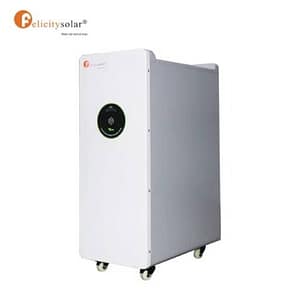
The Felicity 12KWH Inverter is ₦2,000,000. The 12 kWh lithium battery is built inside it, so there is nothing extra to buy. Warranty 5 years. This is the whole-home unit: sized for a 3-bedroom running lights, fans, a fridge, a freezer, a television and a washing machine.
We do not stock a 3 kVA inverter, and we would rather say so than order you one you did not ask us for. The nearest thing to it in the range above is the 2.3 kW 24V at ₦230,000.
A worked example, because “3.5 or 5” only means something with a load behind it
Take a 3-bedroom house in Ilorin on a normal evening. These are typical figures for this class of home, and you should read the label on your own appliances rather than trust mine.
- 6 LED bulbs at 9W, 6 hours: about 324 Wh
- 3 ceiling fans at 60W, 6 hours: about 1,080 Wh
- 1 fridge at 100W running, 10 hours: about 1,000 Wh
- 1 freezer at 100W running, 10 hours: about 1,000 Wh
- Television at 80W, 5 hours: about 400 Wh
- Router and decoder at 25W, 12 hours: about 300 Wh
- Phone charging at 15W, 2 hours: about 30 Wh
That is about 4.1 kilowatt-hours a day, which is the number the battery has to be sized from. Call it 4 kWh.
Now the inverter, which is sized from a different question: what is switched on at the same time, at its worst moment? Bulbs 54W, fans 180W, fridge 100W, freezer 100W, television 80W is about 514W steady. Add one compressor start. A compressor running at 100W can pull roughly 300W for a second, so at that instant the inverter is being asked for about 700W.
So a 1.3 kW continuous inverter carries that home comfortably, and a 2.3 kW unit leaves headroom for a water pump later. A 5 kVA inverter for this load is not an upgrade. It is money spent on a ceiling the house never reaches, and it is the most common way I see people overspend on the one component that was never the problem.
The shop from the question above, sized the same way
A small shop with a POS, a laptop, a television, lights, fans and CCTV:
- 4 LED bulbs at 9W, 8 hours: about 288 Wh
- 2 ceiling fans at 60W, 8 hours: about 960 Wh
- 1 fridge at 100W running, 9 hours: about 900 Wh
- Laptop at 50W, 8 hours: about 400 Wh
- Television at 60W, 6 hours: about 360 Wh
- 4 CCTV cameras at 8W, 24 hours: about 768 Wh
- POS and phone charging at 20W, 8 hours: about 160 Wh
That is about 3.8 kWh a day, and the steady load is about 418W, rising to roughly 620W for the second a compressor takes to start. A small inverter is enough on watts alone — but our 10 kWh bank is 48 V, so the inverter has to be 48 V too, and that is the part the section below settles.
Our shop and small-office sizing guide works through this class of load in more detail.
Then the battery, in kilowatt-hours
The arithmetic is short enough to do on paper:
daily kWh × days of autonomy ÷ 0.85
The 0.85 is the usable fraction of a lithium bank. Our lithium batteries carry a roughly 85% usable against about 50% for lead-acid, which is why a lithium bank behaves like a much bigger lead-acid one in practice.
For the 4 kWh home: 4 × 1 day ÷ 0.85 = about 4.7 kWh of bank for one night. One 10 kWh unit gives you roughly two nights before the inverter stops. For the 3.8 kWh shop on the same maths you land in the same place, which is why the shop above and a 3-bedroom home end up on the same inverter family.
Our four stocked banks, with today’s prices:
- SMS 10KWH Lithium Battery at ₦1,900,000, reduced from ₦1,950,000
- Felicity 10kwh Lithium Battery at ₦2,000,000
- Felicity 15KWH Lithium Battery at ₦4,700,000, for genuine multi-day autonomy or a heavier load
- 30KWH Haisic Lithium Battery at ₦3,800,000, reduced from ₦4,000,000. It is the cheapest storage per kilowatt-hour we stock
Warranty 5 years on all four, and the Capacity and rated Voltage are printed on each product page so you are not relying on a label in a photograph.
All four of those pages now publish the rated voltage, and the answer is the same on every one: 51.2 V nominal, which is the 48 V class. The two 10 kWh units are 51.2 V 200 Ah, the 15 kWh unit is 51.2 V 300 Ah, and the 30 kWh Haisic is 51.2 V 600 Ah. Each page names where its figure comes from. This is the number to read before you spend two million naira, because a bank voltage fixes the inverter you are allowed to pair with it: a 51.2 V bank is a 48 V bank, and a 24 V inverter cannot charge it, whatever the salesman says. If you are comparing a 10 kWh cabinet from us against one from another seller, ask both for the rated voltage first, because a 24 V bank and a 48 V bank are not the same product and neither is the inverter that charges them. Our 24V vs 48V guide explains what that decision costs in cable. We still confirm the exact unit and the bank configuration in writing before you pay, and we correct a page if the manufacturer’s figure differs.
Divide the price by the kWh and you get the honest cost of storage: about ₦190,000 per kWh on the SMS 10 kWh, ₦200,000 on the Felicity 10 kWh, ₦313,000 on the 15 kWh, and about ₦127,000 on the 30 kWh Haisic. Recompute that yourself when you read our prices, because it moves every time we change a price. The method is the number worth keeping: price ÷ kWh, compared against price ÷ watts for the inverter. Those two ratios are the only honest way to compare solar hardware, and almost nobody in this market will do it for you.
The 12V batteries, and why we will not print a kWh for them
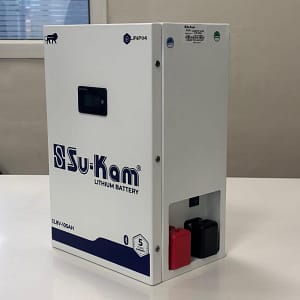
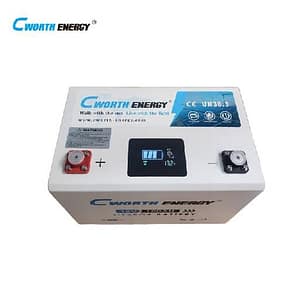
We also stock two smaller 12V units: the Cworth 12V Lithium Battery at ₦260,000 and the Sukam 12.8V Lithium Battery at ₦265,000, both reduced from ₦270,000, warranty 5 years. Note what is missing: neither page publishes an amp-hour rating in its specification. The Cworth page shows 100 Ah in the photograph caption, the Sukam page shows nothing at all. That gap is exactly why the method below matters more than the price.
These are building blocks for small systems, and we will not publish a kilowatt-hour figure for either one, because a 12V label can be inflated in a way a 10 kWh floor-standing cabinet cannot. Here is the method instead. Ask for two numbers in writing before you pay: the amp-hour rating and the nominal voltage. Then multiply them and divide by 1000, and you have kilowatt-hours. 100Ah at 12.8V is 1.28 kWh. Whatever the seller claims on the box, that is the number to check the claim against, and it is the same check our battery bank sizing guide walks through.
Full specification is confirmed to you in writing before you pay, on every item in the shop.
What I would tell that shop, in one message
You asked for a 3kVA inverter and a battery bank for a small shop. Here is the honest version, in the order we would actually decide it.
First, the battery, because it fixes everything else. Your steady load is 418W and your worst instant about 620W, and a SMS 10KWH Lithium Battery at ₦1,900,000 covers about two nights of that evening load. Its rated voltage is now printed on its page — 51.2 V, the 48 V class, 200 Ah, 10.24 kWh — and that one number settles the inverter question before anything is ordered. A battery bank is expensive to change. An inverter is not.
Second, the inverter, and it has to be 48 V. A 24 V inverter cannot charge a 51.2 V bank, so the 2.3 kW 24 V unit at ₦230,000 is not an option for this battery. Our 48 V sizes start at 10.3 kW, which is a great deal of inverter for a 418W shop, and that gap between what the bank needs and what we stock at that voltage is exactly the reason to settle the voltage before you order rather than after. Ask us in writing for either a smaller 48 V inverter or a bank matched to a smaller system, and we will tell you what is available. Ask for the plate rating, not the kVA on the box, because the advertised figure is the least informative thing about an inverter.
Third, panels, and only after the first two are settled, because the array size depends on the bank and inverter you ended up with.
Panels come last, from our 700W Solar Panel at ₦147,000 each.
So the honest total for that shop, on the 48 V bank we actually stock, is the battery at ₦1,900,000 plus the smallest 48 V inverter at ₦1,150,000, which comes to ₦3,050,000 — with the caveat that this inverter dwarfs a 418W load and we would rather quote you a smaller 48 V unit if one is available. An itemised number you can check line by line is what you should get from any seller. If a quote arrives as one lump sum with no plate ratings, no watt-hours and no bank voltage on it, that is the warning, not the reassurance.
What happens next
- You send us your load list, room by room, with the wattage off each appliance if you have it.
- We send a written quote with every line named, including the inverter’s real continuous and surge ratings in watts.
- You buy the hardware from our shop, or we supply it.
- We install and commission it, and show you the system running.
If you would rather not build the list yourself, use the request a quote page and tell us the appliances, or use the WhatsApp button in the shop box at the end of this guide. Either way you get a written quote with every line named, no obligation. Pay today and we deliver within 12 hours in Ilorin, or within 48 hours anywhere else in Nigeria. Read the delivery terms.
Prices are what we charge today, read off our live shop pages on 5 October 2026, and they change with supply. Every product named above links to its page.
Shop the products in this guide
- Sukam 12.8V Lithium Battery
- Cworth 12V Lithium Battery
- Felicity 15KWH Lithium Battery
- Felicity 12KWH Inverter
- Felicity 10kwh Lithium Battery
- Kartel Hybrid Inverter
- 30KWH Haisic Lithium Battery
- 700W Solar Panel
- SMS 10KWH Lithium Battery
Prices are on each product page. Not sure which one you need?
Pay today and we deliver within 12 hours in Ilorin, or within 48 hours anywhere else in Nigeria. On orders over ₦400,000 or any full kit, we agree the date with you on WhatsApp before we dispatch.
Ask us on WhatsApp about “3.5 kVA vs 5 kVA Solar Inverter: Which One…”
0 Comments